
Form 141 for NRI Property Purchase: Buyer Checklist 2026
Contextual link mapForm 141 for NRI Property Purchase: 9-Step Buyer Checklist
Contextual link mapForm 141 for NRI Property Purchase: 9-Step Buyer Checklist
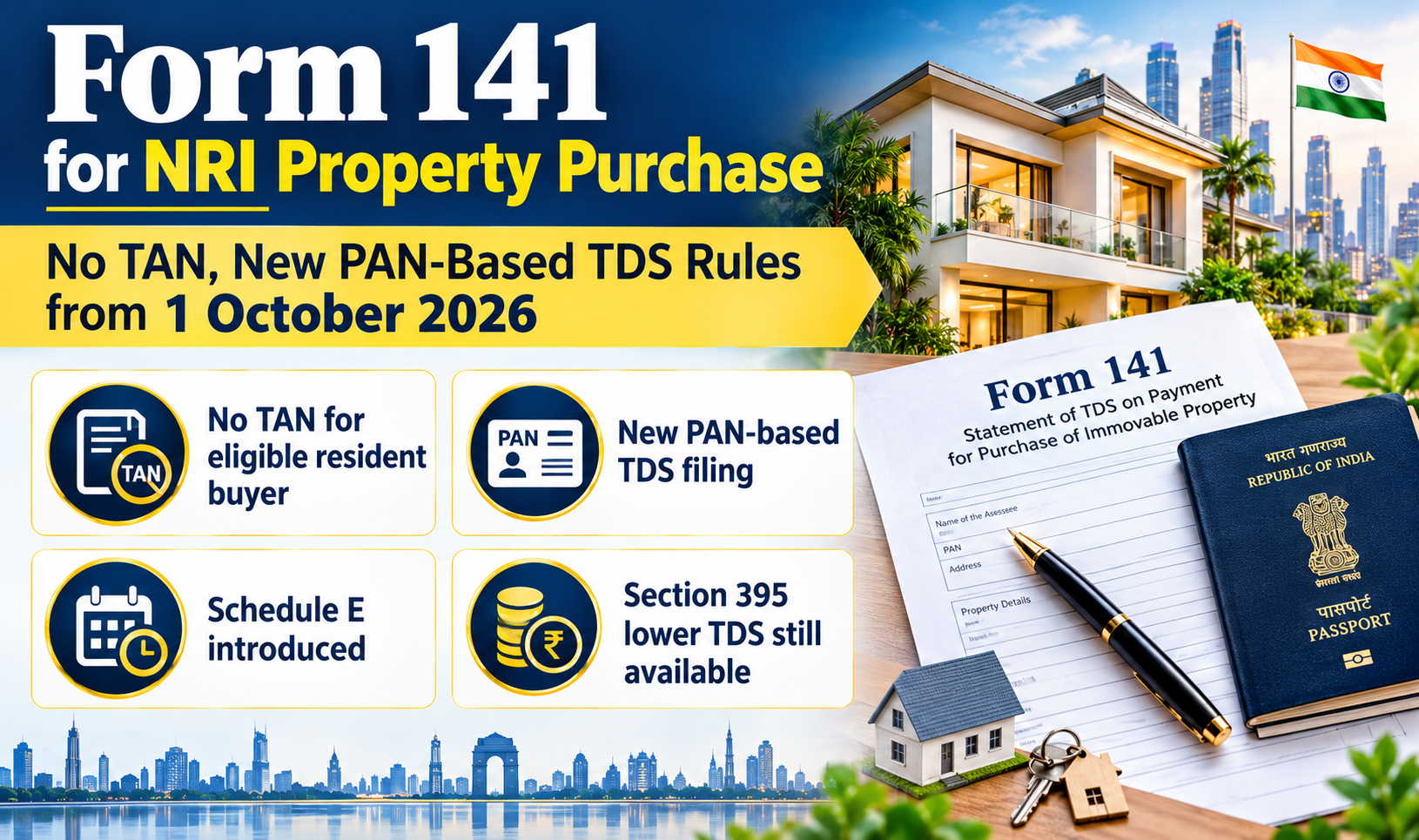
Form 141 for NRI property purchase becomes the key challan-cum-statement route for a specified resident individual or Hindu Undivided Family buying immovable property from a non-resident from 1 October 2026. The change is procedural but important: the eligible buyer can use a PAN-based route instead of obtaining a TAN solely for this transaction.
The TDS obligation itself does not disappear. Buyers still need to identify the seller’s residential status, determine the correct tax rate, deduct at the right time, deposit the tax, file the transaction details and provide the prescribed certificate. The new process simplifies the account number used; it does not convert an NRI sale into the familiar resident-seller one-per-cent regime.
| Quick answer: For qualifying transactions on or after 1 October 2026, use the amended Form 141 and its new Schedule E. Use the buyer’s PAN login, collect the NRI seller’s complete overseas and tax details, determine the legally correct deduction rate, and issue Form 132 after filing. |
What changed from 1 October 2026?
CBDT Notification No. 121/2026, dated 22 September 2026, introduced a new Schedule E in Form 141 for specified purchases of immovable property from non-residents. The framework is intended for a resident individual or HUF who is not otherwise required to obtain TAN for the transaction.
Before relying on the new route, read the detailed Form 141 rule update. It explains the transition from the older TAN-based process and flags the information expected in the new schedule.
| Point | Earlier position | From 1 October 2026 |
| Account used | TAN-based compliance commonly applied to a buyer deducting tax from an NRI seller. | Eligible specified buyer uses PAN-based Form 141. |
| Reporting section | Regular TDS reporting workflow. | New Schedule E records the non-resident property transaction. |
| Certificate | TDS certificate under the applicable older process. | Form 132 is the prescribed certificate under the amended framework. |
| Tax rate | Determined under the law, including any lower-deduction certificate. | Still determined under the law; no automatic one-per-cent rate. |
Who should use the PAN-based route?
The route is designed for the specified class of resident individual or HUF buyer covered by the amended rules. A company, partnership, business already required to hold TAN, or a transaction outside the notified class should not assume the concession applies. The operative date also matters: do not force a pre-1 October deduction into a post-1 October form merely because the property registration occurs later.
If the buyer, seller or transaction structure is unusual, obtain a written review through NRI taxation and FEMA support before releasing consideration. Residential status is determined under tax law; nationality, passport, OCI status or an Indian address alone may not answer it.
The 9-step Form 141 buyer checklist
1. Confirm the seller’s tax residential status. Ask for a declaration and supporting evidence. The decisive question is whether the seller is non-resident for the relevant tax year.
2. Map the payment timeline. List the agreement date, registration date, each instalment, advance and amount credited. TDS timing follows the governing law, not merely the final registration date.
3. Collect identity and overseas details. Keep the buyer’s PAN and the seller’s PAN, if available, together with the seller’s name, status, contact details, email and overseas address. Schedule E also requires transaction-specific tax information.
4. Capture the property data exactly. Use the registered address, property type, consideration, stamp-duty value and ownership shares. In a multi-buyer or multi-seller deal, prepare a party-wise working rather than dividing amounts casually.
5. Determine the rate before paying. Do not apply the resident-seller one-per-cent rule. The rate can depend on the nature and period of the capital asset, surcharge, cess, the seller’s PAN position and any valid lower-deduction certificate.
6. Review a lower-deduction certificate. An NRI seller may seek a certificate allowing tax to be deducted on an assessed gain or at a lower rate. Verify that the certificate is valid, covers the buyer and transaction, and has sufficient unutilised amount.
7. File the correct Schedule E. Use the income-tax portal path applicable to Form 141 after the amended form goes live. Do not select the resident-property schedule merely because both concern immovable property.
8. Pay and retain the acknowledgement. Reconcile the challan amount, bank debit and filed form. Save the acknowledgement, payment reference and computation in one transaction folder.
9. Issue Form 132 and close the file. Download or generate the prescribed TDS certificate within the applicable timeline, give it to the seller and match the transaction in the buyer’s and seller’s records.
TDS rate: the most expensive place to guess
A buyer’s risk is not limited to late filing. Short deduction can lead to interest, exposure as an assessee in default and transaction disputes. The sale price is also not necessarily the taxable gain. Yet the buyer cannot simply accept an informal gain calculation supplied by the seller and deduct on that number unless the law or a valid certificate supports it.
For hands-on execution, use property TDS filing assistance. For a Delhi-based transaction or face-to-face review, the income-tax services in Dwarka page provides a local route. These links should appear once each and only beside the relevant reader need.
Documents to keep in the transaction file
- Agreement to sell, sale deed draft and payment schedule.
- PAN and status details of every buyer and seller.
- Seller’s overseas address, email, mobile number, tax identification number and tax residency information where required.
- Stamp-duty valuation and the basis for the amount subject to deduction.
- TDS rate working, surcharge and cess calculation, and professional advice relied on.
- Lower-deduction certificate and utilisation working, if applicable.
- Form 141 acknowledgement, challan, bank debit evidence and Form 132.
Common mistakes to avoid
- Treating an NRI seller as resident because the seller has an Indian PAN or bank account.
- Using the resident-property schedule or a flat one-per-cent rate.
- Filing one form for multiple buyers without checking the separate-deductor requirement.
- Ignoring instalments paid before registration.
- Applying a lower-deduction certificate to the wrong buyer, property or amount.
- Assuming removal of the TAN step also removes the need for a correct rate computation and certificate.
How this article should link within TaxParley
Add a contextual link to TaxParley’s existing guide on NRI property TDS rules using a supporting—not identical—anchor. After publication, link back to this checklist from that guide so both pages form a two-way topic cluster.
Frequently asked questions
Is TAN completely abolished for every NRI property purchase?
No. The relaxation is for the specified resident individual or HUF and the notified transaction route. Other deductors or transactions may still need TAN-based compliance.
Does Form 141 mean TDS is only one per cent?
No. The one-per-cent rule associated with many resident-seller property purchases should not be carried over to a non-resident seller. Determine the rate under the applicable law or a valid lower-deduction certificate.
What is Schedule E of Form 141?
Schedule E is the new part of Form 141 designed to report the specified immovable-property transaction where a resident individual or HUF buys from a non-resident.
What certificate is issued to the NRI seller?
The amended framework prescribes Form 132. The buyer should retain proof of issue together with the Form 141 acknowledgement and tax payment.
Can one buyer file for all co-buyers?
Do not assume so. Each deductor’s filing position should be checked separately, especially where ownership and payment shares differ.
Editorial sources and review date
Facts checked on 26 September 2026. Recheck official notices immediately before publishing because banking operations, portal instructions and procedural forms can change.
- Income Tax Department — Form 141 help and FAQs
- CA Alok Kumar — Form 141 for NRI property purchase update