
Bank Strike September 2026: 12-Point Taxpayer Checklist
Contextual link map
| Domain | Recommended anchor | Destination | Purpose |
| wealth4india.com | bank strike September 2026 customer update | https://wealth4india.com/insights/bank-strike-september-2026/ | Primary update |
| caalokkumar.com | Form 145 and Form 146 remittance support | https://caalokkumar.com/form-145-146-ca-certificate-foreign-remittance.html | Cross-border action |
| caindwarka.com | income-tax services in Dwarka | https://caindwarka.com/income-tax-services-dwarka.html | Local tax help |
| itrkendra.com | online income-tax return filing | https://itrkendra.com/income-tax-return-filing | Filing intent |
Bank Strike September 2026: 12-Point Taxpayer Checklist
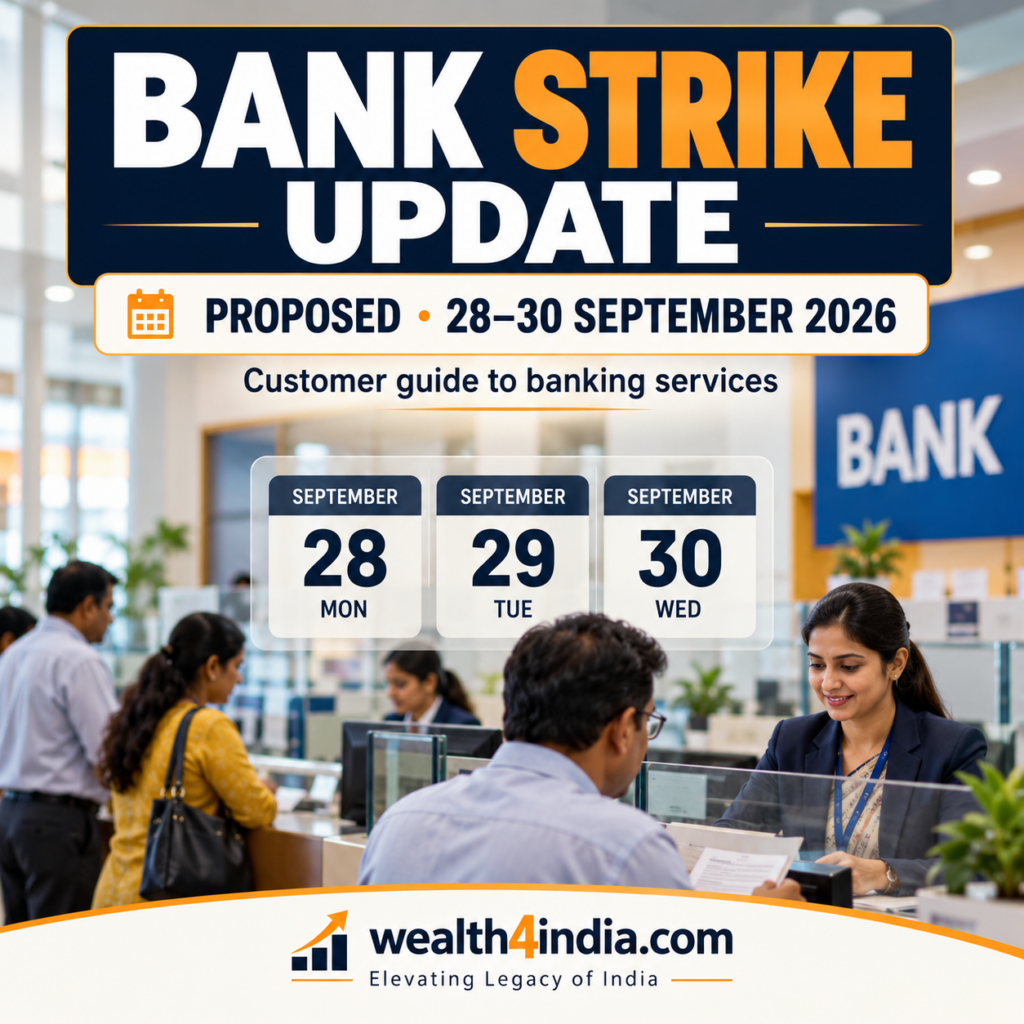
The proposed bank strike September 2026 is scheduled for 28, 29 and 30 September. For taxpayers and businesses, the practical issue is not whether every branch will be closed; it is whether a time-sensitive payment or document depends on bank staff, a branch mandate, a transaction limit or manual approval.
Bank Strike September 2026 : As of 26 September 2026, the action remained described as a proposed nationwide strike. Public-sector banks and regional rural banks were separately directed to operate on Sunday, 27 September. Customers should still check their own bank’s current notice before acting because participation and service levels can differ.
| Status on 26 September 2026 : The strike is proposed for 28–30 September. It is not a declared nationwide bank holiday. Digital rails such as NEFT and RTGS are designed for round-the-clock availability, but a transfer can still be affected by channel limits, bank controls, incorrect beneficiary data or staff-dependent resolution? |
Why taxpayers should plan before the strike dates
Bank Strike September 2026 : A statutory deadline normally does not move merely because a strike is announced. A portal-generated challan may remain payable online, but large-value transfers, newly added beneficiaries, failed debits, branch-authorised payments and outward remittances can need human intervention. A “payment initiated” screenshot is also not the same as successful credit to the government or beneficiary.
For the broader customer position and confirmed Sunday opening, see the bank strike September 2026 customer update. The checklist below narrows the issue to tax, compliance and business continuity.
12 actions to take before 28 September
1. List every payment due through 30 September. Include direct tax, TDS, GST, customs, payroll, vendor dues, rent, loan instalments and contractual deposits. Record the due date, amount, payment channel and approving person.
2. Generate tax challans early. Create the challan, verify PAN/TAN/GSTIN, assessment or financial year, tax type and amount before initiating payment. A wrong field can be harder to correct than a late start.
3. Test transaction limits. Confirm internet-banking, corporate-banking, UPI, NEFT and RTGS limits. Check whether an administrator must raise the limit or a second user must approve the payment.
4. Activate beneficiaries now. Some banks impose a cooling period on new beneficiaries or cap the amount immediately after activation. Add and verify beneficiaries before the deadline.
5. Complete maker–checker approvals. A maker can prepare a transaction without completing it. Ensure the checker and final authoriser will be available and has a working token, mobile device or DSC.
6. Confirm government credit. After paying tax, save the challan identification number, bank reference and portal status. Recheck later if the portal shows pending or the debit is reversed.
7. Prepare foreign-remittance files. Outward remittances can involve Form 145/146 documentation, purpose codes, invoices and authorised-dealer review. Arrange Form 145 and Form 146 remittance support before approaching the bank.
8. Submit branch documents on 27 September where applicable. Public-sector bank and RRB customers have an extra working day. Call the branch first and confirm the counter, staff and service hours for the exact request.
9. Reconcile payroll and vendor files. Upload files early, resolve rejected records and verify a sample of beneficiary credits. Keep an alternate authorised user available.
10. Plan cash without panic. Estimate genuine operating needs, check ATM or cash-deposit-machine options and avoid unnecessary withdrawals driven by “five-day closure” headlines.
11. Keep evidence of attempts and escalation. Retain emails, service-request numbers, error messages and bank references. They may help explain events but should not be treated as an automatic waiver of interest or late fees.
12. Assign one person to monitor updates. Use the bank’s official website, app, branch contact and verified government notices. Update the payment tracker when the strike status or bank arrangement changes.
Which services are most exposed?
| Task | Likely channel | Main risk | Action |
| Tax or GST payment | Portal + bank gateway | Limit, failed debit, pending status | Pay early and verify challan |
| TDS payment | Portal/net banking | Wrong details or delayed confirmation | Review before payment; save proof |
| Outward remittance | AD bank + documents | Manual compliance review | Submit file and confirm cut-off |
| Payroll/vendor batch | Corporate banking | Maker–checker or rejected records | Upload, approve and sample-check |
| Demand draft/branch mandate | Physical branch | Counter or staff availability | Use 27 September if confirmed |
| Failed online transfer | Digital + support desk | Resolution may need staff | Raise ticket immediately |
Tax filing and banking are separate steps
Bank Strike September 2026 : An income-tax return may be prepared and uploaded even when a related payment is still pending, but the correct course depends on the return, tax payable and deadline. Taxpayers who still need to prepare or revise their return can use online income-tax return filing. Those needing local document review can use income-tax services in Dwarka.
These service links should not be inserted in the opening paragraph. Place them beside the relevant action so they function as useful next steps rather than decorative backlinks.
What not to claim in this article
- Do not say every bank will be closed for five consecutive days.
- Do not state that the strike is cancelled unless a later official notice confirms it.
- Do not promise that every private-bank branch will open on 27 September.
- Do not promise uninterrupted digital service; say central systems are scheduled for continuous availability, subject to the bank and channel.
- Do not imply a strike automatically extends a tax, regulatory or contractual deadline.
Frequently asked questions
What are the bank strike dates in September 2026?
The proposed nationwide strike dates are 28, 29 and 30 September 2026. Customers should check for a later settlement, deferment or bank-specific advisory.
Will NEFT and RTGS work during the bank strike?
NEFT and RTGS are designed to operate 24×7×365. However, customer limits, bank channels, beneficiary cooling periods and failed-transaction support can still affect completion.
Does the bank strike extend tax payment deadlines?
Not automatically. Unless the competent authority issues a specific relaxation, plan on the original statutory deadline.
Should a business delay payroll until the strike ends?
No. Where possible, upload and approve payroll early, then verify credits. Keep transaction references and a contact path for rejected or missing payments.
Are banks open on 27 September 2026?
The government announced normal functioning for public-sector banks and regional rural banks on that Sunday. Confirm the particular branch, customer hours and service before visiting.
Editorial sources and review date
Facts checked on 26 September 2026. Recheck official notices immediately before publishing because banking operations, portal instructions and procedural forms can change.
- Wealth4India — bank strike customer guide
- Reserve Bank of India — NEFT FAQs
- Reserve Bank of India — RTGS FAQs