Class 3 DSC Online: 7-Step MCA, GST and ITR Checklist
Class 3 DSC Online: 7-Step MCA, GST and ITR ChecklistClass 3 DSC online applications look simple until the certificate reaches the wrong person, lacks an encryption component, uses mismatched identity data or cannot be registered on the target portal. The right starting question is not “Which DSC is cheapest?” but “Who will sign, for which entity, on which portal, and does that portal need signing only or signing plus encryption?”
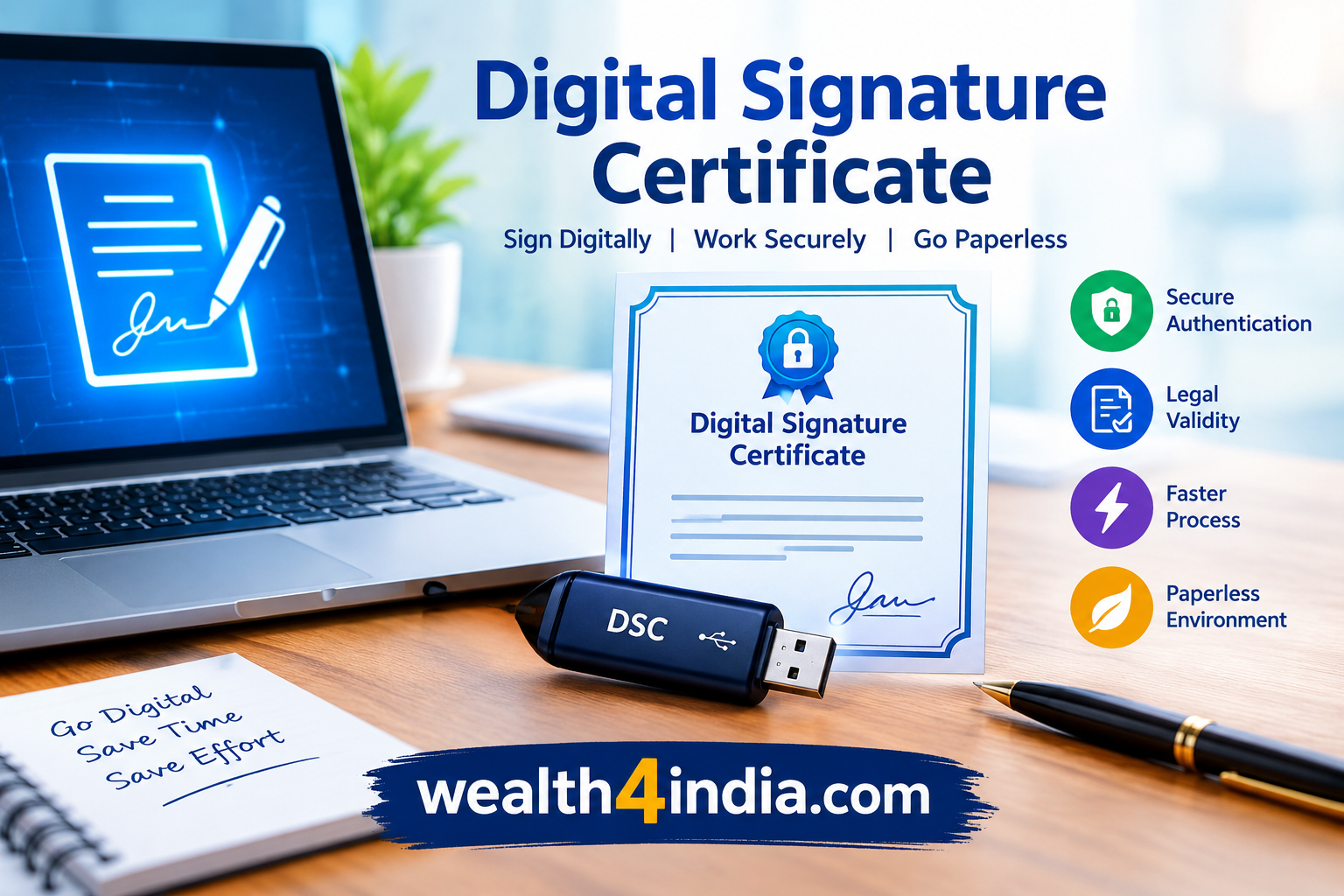
A Digital Signature Certificate is issued to an end user by a Certifying Authority licensed under India’s public key infrastructure framework. It authenticates the signer and protects the integrity of the signed electronic record. The certificate belongs to the named subscriber; it should not be treated as a shared office password.
| Fast choice: Use an individual signing DSC for common personal or authorised-signatory filings where the portal permits it. Choose an organisation certificate when the portal or transaction requires the entity name. Choose a signing-plus-encryption combination only when the target portal or tender specification requires encryption. |
Where a Class 3 DSC is commonly used
| Use case | Typical certificate need | Check before buying |
| MCA / ROC | Individual DSC of director, designated partner, subscriber or professional | Name, DIN/PAN, role and MCA registration |
| GST | DSC for authorised signatory where required by entity type or chosen method | Authorised signatory and portal mapping |
| Income tax | Individual DSC for specified filers, audit forms and authorised users | PAN match, principal contact and signer utility |
| e-Tender / GeM | Often signing + encryption; may require organisation identity | Tender specification and bidder name |
| DGFT / ICEGATE | Certificate mapped to authorised person and organisation/IEC as required | IEC, role and portal rules |
| PDF or contracts | Signing certificate | Counterparty acceptance and signature policy |
Seven steps to get the right DSC
1. Identify the subscriber. Decide whether the certificate is for an Indian individual, authorised signatory, NRI, foreign national or authorised person of a foreign organisation. The certificate must be issued in the actual signer’s name.
2. Name every target portal. List MCA, GST, Income Tax, EPFO, DGFT, ICEGATE, GeM, CPPP or the relevant state tender portal. Do not buy before checking each portal’s current requirements.
3. Choose signing or combination. Signing proves authorship and integrity. Encryption protects bid or data content. A combination certificate is useful only when the use case needs both.
4. Choose individual or organisation identity. A certificate may identify only the individual or also carry organisation context. Tender documents and entity workflows often control the choice.
5. Confirm identity-verification route. Indian applicants may have Aadhaar eKYC, banking KYC or document-based routes depending on the Certifying Authority. NRIs and foreign nationals follow the applicable passport and overseas-address verification rules.
6. Complete video and token issuance. Use your own mobile and email where required. Check the subscriber name before the certificate is downloaded to the approved cryptographic token.
7. Install, register and test early. Install the token driver and portal signer utility, register the DSC on each portal, sign a test document or non-critical form, and record the expiry date.
Documents required: practical matrix
| Applicant | Core documents | Additional checks |
| Indian individual | PAN; Aadhaar or other accepted ID/address proof; photo; mobile; email | Identity details must match portal data |
| Indian organisation signatory | Entity registration/PAN; authorisation; signatory KYC | Authority, designation and organisation name |
| NRI | Indian passport; overseas address proof; photo; mobile; email; PAN if available | Verification and attestation route can vary |
| Foreign national | Foreign passport; overseas address proof; photo; mobile; email | Translation/attestation as applicable |
| Foreign organisation | Entity registration; authority document; signatory passport/address proof | Entity and signatory linkage |
The exact list depends on the Certifying Authority and verification method. Before paying, compare the documents against the Class 3 DSC documents guide and obtain a case-specific checklist. If the route is confirmed, readers can apply for a Class 3 DSC online.
Class 3 DSC for MCA and company compliance
MCA filings fail when the signer’s name, PAN, DIN, role or registered certificate does not match portal data. Incorporation can also involve subscribers and directors in different countries, each with their own verification route. Businesses needing annual filings, director KYC or charge-related work can review ROC filing services.
For a new entity, obtain the certificate early enough to test the MCA environment before the filing date. Delhi-based founders combining incorporation with DSC support can use the company registration in Dwarka page as the local next step.
Class 3 DSC for GST and income tax
The portal may require the DSC to be registered against the authorised signatory or principal contact. A certificate can be technically valid yet fail because PAN, name, role or portal registration is wrong. Install the prescribed signer utility, keep the token driver current and test before a return or audit deadline.
A taxpayer who needs return preparation as well as DSC registration can use online income-tax return filing. Keep the anchor descriptive: “online income-tax return filing” tells readers and search engines what the destination offers.
Errors that waste time and money
- Buying a signing-only certificate for a tender that requires encryption.
- Using an individual certificate where the tender specifies organisation identity.
- Issuing the certificate with a spelling, PAN or passport-name mismatch.
- Sharing the token and PIN across staff instead of controlling subscriber use.
- Assuming every foreign document always follows the same apostille or embassy route.
- Waiting until the filing deadline to install the driver, signer utility and root certificate.
- Replacing or formatting the computer without recording token software and certificate details.
Security and renewal checklist
- Keep the token physically secure and never email or message the PIN.
- Revoke the certificate promptly if the token is lost or compromise is suspected.
- Do not allow an employee or intermediary to retain the token after the authorised task.
- Record the expiry date and begin renewal before a critical filing period.
- After renewal, re-register or update the certificate on each portal where required.
- Verify signed PDFs through the signature panel and certificate chain, not only the visible image.
Frequently asked questions
What is a Class 3 DSC?
It is a high-assurance Digital Signature Certificate issued after identity verification by a licensed Certifying Authority and used for secure electronic signing on government and business portals.
Can one DSC be used for MCA, GST and income tax?
Often, the same individual signing certificate can be registered on several portals, but each portal’s role, entity and registration rules must be satisfied separately.
Do I need signing only or signing plus encryption?
Signing-only is sufficient for many returns, forms and PDFs. e-tendering or procurement specifications may require a combination certificate with encryption.
Can an NRI or foreign national get an Indian DSC?
Yes. The CCA framework allows DSC issuance to foreign nationals, subject to the applicable identity-verification process. NRI and foreign-national document routes are not identical.
Is a USB token required?
A cryptographic token is commonly used for Class 3 DSCs. Confirm the current Certifying Authority and portal requirements, and do not share the token or PIN.
Can an expired DSC be extended?
Renewal generally involves issuance of a fresh certificate, potentially on a compatible existing token. Re-register the renewed certificate on portals where required.
Editorial sources and review date
Facts checked on 26 September 2026. Recheck official notices immediately before publishing because banking operations, portal instructions and procedural forms can change.
- Controller of Certifying Authorities — how to get a DSC
- Controller of Certifying Authorities — licensed Certifying Authorities
- Controller of Certifying Authorities — DSCs for foreign nationals
- DSC Sep 29, 2026, 05_35_11 PM
| Disclaimer: Portal requirements, certificate products, prices and verification routes can change. Confirm the current requirement with the target portal and a CCA-licensed Certifying Authority before applying. |
Final publication checklist
- Use the supplied SEO title and slug; keep the visible H1 aligned with the SEO title.
- Paste the meta description exactly or keep any revision within the search snippet limit shown by Rank Math.
- Add the focus keyword to Rank Math and add the secondary phrases individually—not as one comma-heavy focus phrase.
- Use a unique featured image for each article. Set the supplied alt text; do not stuff extra keywords into the filename or caption.
- Retain the first-paragraph keyword placement, descriptive H2s, lists, comparison tables and FAQs.
- Open every contextual link in a new tab only if that matches the site’s editorial policy. Do not use nofollow on genuine editorial cross-site references solely because the sites are related.
- Add author credentials and a reviewed/updated date. For tax guidance, show the professional reviewer where available.
- Publish Article schema. Publish FAQPage schema only when the same questions and answers are visible on the page.
- For the two banking articles, update the status immediately if the strike is deferred, withdrawn or modified.
- After publishing, add reciprocal contextual links from relevant existing pages and request indexing in Google Search Console.
- Track query impressions, average position, CTR and assisted clicks for at least 28 days before rewriting titles again.
Recommended interlinking after publication
| New TaxParley page | Link from | Suggested anchor |
| Form 141 checklist | Existing TaxParley NRI property TDS article | Form 141 buyer filing checklist |
| Bank strike taxpayer checklist | TaxParley compliance or payment update page | September bank strike payment checklist |
| 27 September Sunday opening | Bank strike taxpayer checklist | banks open on 27 September 2026 |
| Class 3 DSC checklist | TaxParley MCA/GST/ITR filing pages | choose the right Class 3 DSC |